


The Circle Around the Hole: A Lesson in Leadership and Action Planning
Jun 17, 2026
Yesterday, I took a golf lesson. I must admit that I love golf, but I rarely have time to practice or play.
We started on the driving range, hitting different irons toward flags in the distance and working to dial in the yardage for each club. Along the way, we were also focused on improving our form, mechanics, and follow-through.
One of the things that struck me was how differently each golfer responded to feedback from the pro. The cue that worked perfectly for one person didn’t necessarily resonate with another. It’s fascinating how our minds process instruction…what clicks for one person may completely miss the mark for someone else.
For me, the golf professional noticed that my backswing was too tight. Her feedback was simple: pull the club farther away from your body during the backswing. That cue immediately made sense to me. It gave me a visual I could understand and apply.
Getting Closer to the Hole
After our time on the driving range, we drove over to the practice putting green.
I’ll admit it that putting is not my favorite part of golf. Yet every golfer knows that is where scores can quickly rise. A missed putt here and there can add up in a hurry.
As I stood on the putting green, I found myself thinking about the game as a whole. From the tee box, the hole is often hundreds of yards away. There are countless paths to reach it successfully. But as you get closer to the hole, the margin for error becomes smaller. The game becomes more technical, more strategic. The slopes matter. The speed matters. An uphill putt requires a different approach than a downhill one.
The Circle Around the Hole
Then, as we were standing on the beautifully manicured green, the golf pro did something unexpected.
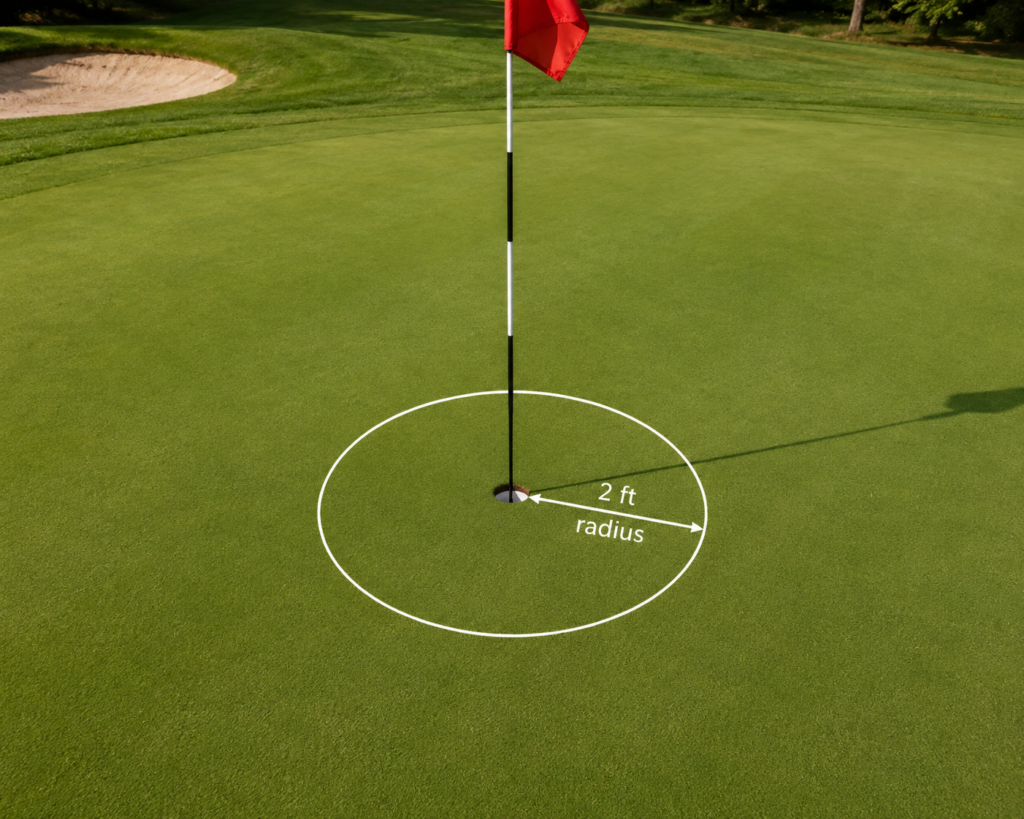
She stepped about two feet away from the hole and shuffled around it, creating an imaginary circle with a two-foot radius. She told us that our goal was not necessarily to make every putt. Instead, our goal was to get the ball in the inside that circle.
The hole remained the ultimate target, but the circle became the immediate objective.
She explained that golfers who consistently putt within that two-foot circle dramatically increase the likelihood of making the next putt (like by 95%). Suddenly, the task felt different. More attainable. More manageable.
The goal had not changed, but my perspective and motivation had.
For someone who has played golf for years, this simple visual was surprisingly powerful. It reframed success. Instead of focusing exclusively on sinking a long putt, I could focus on making meaningful progress toward the hole.
Reframing Success
As leaders, there is an important lesson here.
Our responsibility is not simply to present information. It is to help others understand it. Sometimes a concept, strategy, or piece of feedback does not connect because the learner cannot yet visualize success. When that happens, our role is not to repeat the same message louder. Our role is to find a different way to frame it.
If one approach doesn’t work, how might we reframe it?
How might we create a visual, an example, a story, or a smaller target that helps someone see what is possible?
The Essence of Action Planning
This is the essence of action planning in leadership.
The leader’s job is not to move the hole closer or to make the hole bigger. The leader’s job is to help people see the circle around it, so they can see the next achievable target. This transforms a distant vision into meaningful progress. Vision inspires, but action plans create momentum. While the destination remains the same; the pathway becomes clearer.
The best leaders understand that people rarely move forward because they are told where to go. They move forward because they can see the next step and have vision toward a meaningful goal or outcome.
Whether we are leading an improvement effort, implementing a new initiative, developing a team, or helping others to grow, our responsibility is to translate vision into action. We do that by creating milestones, identifying leverage points, and helping others experience success along the way.
Sinking the putt still matters. In fact, it matters tremendously.
But sometimes the most important work of leadership is drawing the circle around it first.
Questions to consider:
What would change if, instead of asking people to aim directly for the hole, we first helped them see the circle around it?
What might be the “circle around the hole” (a smaller, more attainable target) that would help you make meaningful progress?
What feedback has “clicked” for you recently, and why did it resonate when other feedback did not?
Leave a Reply
Join the ED Nook List!
Sign up and get the latest blog posts, news, and more from ED Nook!
Contact Us
Reach out with any questions or requests for executive coaching or leadership consulting quotes here. We look forward to connecting with you!
Thanks! We received your message and will get in touch soon!

